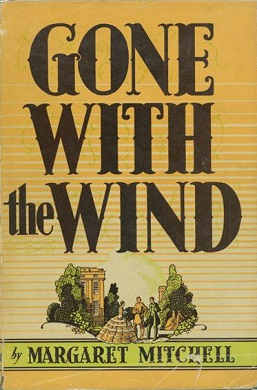
Gone With the Wind begins with the line "Scarlett O'Hara was not beautiful." Though, whenever people envision her, they envision the beautiful actress who played her, Vivien Leigh, with her sharp eyebrows and her beautiful eyes. Her skin is flawless, and so is her acting. But the book says that Scarlett O'Hara was not beautiful. So where does that leave us? It leaves us with the rest of the book's description. Scarlett is, instead, charming, and her face may not have perfect beauty, but it is eye-catching and for it seems, that is enough for Ms Scarlett O'Hara. Though her thick eyebrows and her sharply blended face may not be something that our culture finds beautiful today, you could envision her and see such the woman described - imperfect but charming, eye-catching, pleasing.
In a way, I feel that this is a metaphor for the aristocrat's view of the south, or at the very least, the slave-owners. They saw places like Tara as being Paradise, they saw the south as a place where of course there would be a problem here and there, but it seemed flawless to them, enough so that they went to war over it. Of course, places like Tara weren't perfect, but in the eyes of Scarlett O'Hara is was. She defends Tara, gets angry at anyone who criticizes Tara, especially towards the end. Most US citizens now do not see the South back then as being Paradise, instead, they see a land full of tyrants and racism. Even poor whites were discriminated, but to people like Scarlett, that was the way of life. Though Scarlett's character and friendship with the negroes who worked for her has gotten much criticism and accusations of "romanticizing slavery", though Scarlett still goes to get angry at Prissy because she told a lie, a lie that was totally reasonable, and seemed real. Still, Scarlett is one of the kindest to her slaves.
Many people find the idealized perfection of the south portrayed in the book and film to be erring, it is too perfect for the south that we hurt, the south that was rebellious but we brought back to earth. The personal version of it forces us to see that there were people who would have cooperated with the North but were caught up in a war that hurt them and their loved ones, their homes and their lives. When I first saw the movie (I saw it before the book, which in this case may be understandable for a 10-year old) I realized that what my fifth grade teacher had told me about the south was only half true, as she hadn't stopped to think about the fact that the people back then, down south, were real people not just the slave-owners history makes them out to be. Pat Conroy describes the book perfectly, a literary monument to a place that lost a war. Whoever wins writes history, but whoever loses is memorialized. And though many may not like it, as they don't want to face the humanization of the people they have resented for so long, they have to realize that there is no clear right and wrong, especially when it comes to war, as not everybody in the war has the exact same story as the man fighting next to him.

No comments:
Post a Comment